A while back, I was talking with a friend of mine who pointed out a podcast episode called, “The Ceremony.” It was about the launch of a new cryptocurrency. It reminded me of 2013 when I’d experimented with Bitcoin mining. I had some mining gear laying around, albeit old technology, and thought it might be fun to play around with some alt-coins.
I poked around online looking for a coin that I could mine without being outgunned by some of the monster ASIC mining rigs that were mining Bitcoin and other popular coins. I was amazed to see how the cryptocurrency world had changed. When I tried this a few years ago, the mining was all done with the original algorithms that started with Bitcoin. Since then, Bitcoin had suffered some criticism for not being as anonymous as it was originally thought and had its mining dominated by miners with a large enough investment to buy expensive hardware (the aforementioned ASIC mining rigs). As a result, new coins with different mining algorithms designed to make mining “fairer” and make spending more anonymous had been created. The number of coins had exploded as different groups were competing for their coins to be the next Bitcoin.
I found Z-cash (ZEC) which was based on an algorithm called Equihash. Equihash requires a lot of memory making it easier to do with a computer than with an ASIC. It had also originated as a Linux only miner, which gave an advantage to people with Linux skills. My Linux machine was a hyperthreaded dual quad-core Xeon machine with 48 GB of RAM, which I thought would be moderately better than what most miners were using. Lastly, ZEC was trading for over $200 per coin, making it a worthwhile return.
I found a set of instructions for setting up a CPU miner and set up a Z-cash mining node. It ran for a long time but didn’t find anything. I wasn’t part of a pool and mining on my own, even with good hardware, didn’t compete with the other miners out there. I decided that I would find a better mining software, and maybe a GPU (basically, using the computing power of a graphics card to mine).
While I was looking for better mining software, I found a set of installation and setup instructions that showed how to configure the miner for Nicehash. I thought to myself, “what is Nicehash?” Sure enough, Nicehash can be found at www.nicehash.com.
After a little reading and a couple of Youtube videos, I learned that Nicehash is a service that sells mining computing power. If you want to run a 5 megahashes per second miner. You pay a fee to Nicehash, declare where you want to mine, and they do your mining for you. Where do they get that computing power? They are also a site where people with mining software and hardware can sell their computing power. In simple terms, they buy computing power from me and sell it to someone else. The best part is this: whether I find a coin or not, no matter what coin the buyer is looking for, I get paid Bitcoin for my efforts.
This quickly became something that I had to try. I had given up on bitcoin a while back because I was frustrated with not finding anything. Now, I could create a stream of coin. The challenge now was to maximize that stream.
I downloaded the Nicehash miner, which is a windows program that can use your graphics card or CPU or both to mine coin. I started running on my two Xeons. Doing this brought in about $.67 cents a day. It was fun. I finally had some small amount of Bitcoin. But I wasn’t going to have any real income in this manner. In fact, with the minimum required amount to receive withdrawals being 0.001 Bitcoin, I could only get payouts once a week. I wanted at least a nightly payout.
For the next phase of the project, I bought a pair of GTX1080TI Graphics cards. They were listed as the best GPUs that I could get for NiceHash. Essentially GPUs are computing cores on a graphics card that the computer can ask to do mathematical tasks like hashing algorithms (which is most of the mining work). I built a computer to house the GPUs. This is a lot like a typical computer, but needs to spread the cards out wider for air flow, and isn’t as powerful, in terms of processor or RAM, because the GPUs do most of the work. Once the hardware was assembled, I started mining with the GPUs.
The GPU solution netted me around 0.0012 Bitcoin per day. This was enough to get me a daily payout of $5.00 per day. This doesn’t sound like much; however, I could earn $150 per month at this rate, which could buy something meaningful. I was happy with this, but still wanted to experiment with an ASIC miner.
I had played with some older ASIC miners that are cheap buys on eBay. This was fun, and allowed my to stock up on alt-coins. It wasn’t much good for Nicehash, because the pricing structure rewards speed. The speed of the pools on Nicehash is driven by other people with ASIC miners. So, to maximize payouts, I needed something big.
I settled on an L3+ miner, which is the miner that Nicehash shows as its most effective miner on their profitability calculator. These are simpler to set up: buy a miner, buy a power supply, plug them in, point it at Nicehash, and start mining. Once I got this going, it churned out ~ $20/day. The following chart illustrates the difference in mining equipment.
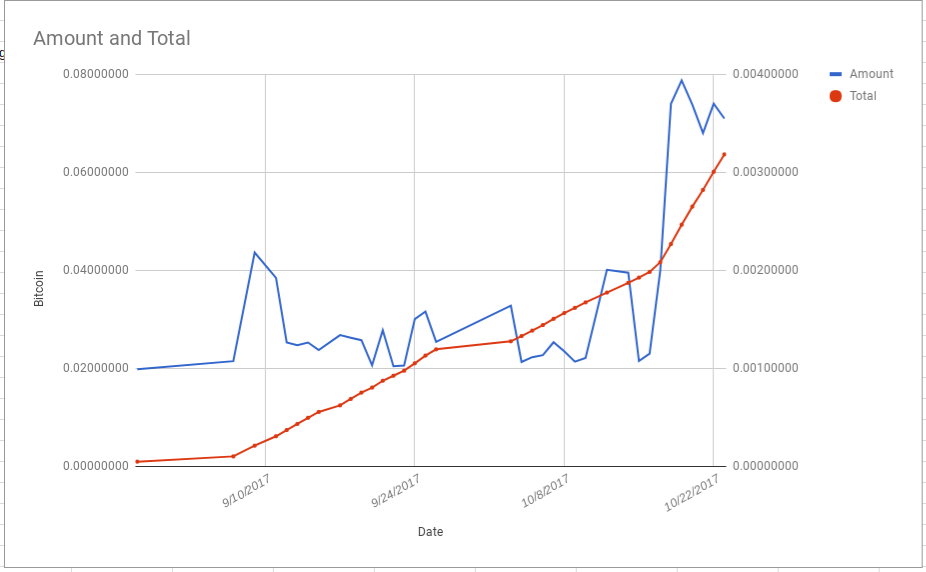
The first red line segment with the modest slope is the aggregated total of the CPU miner. It is a steady churn of coin with payments spread out over weeks. You can see this in the blue line where the two points on this line are just above 0.001 bitcoin (on the right scale). At the third point on each line, you see the effect of switching to the GPU miner. There’s a big spike on the blue line (as there was some residual from the CPU added to the first GPU payment), followed by a daily total over 0.001 bitcoin. This slope continues until late October when the slope turns upward and the payout line goes up to ~ 0.0035 per day. This is the payout from the ASIC miner. Lastly, the nearly flat line segment in the center was due to me switching the GPU over to another mining site, to experiment with Z-cash mining. The line isn’t flat, because the CPU miners were still running on Nicehash.
I’ll report more, as I learn more.



 Daniel Gregson
You must be logged in to post a comment.