One of the best apps that I’ve found for ham radio on the road is the Repeater Book App. I’ve used it for years on both Android and my iPhone. It has all of the content of the Repeater Book website but uses the GPS on your phone to tell you which repeaters are closest to you.
Once you choose a repeater that you would like to use, it has all of the pertinent information to set that repeater up on your radio: frequency, offset, PL tone, wide/narrow band, etc.
I thought all of this was great. However, what really puts it over the top is that it caches its content on my phone. I discovered this while camping at Brooks Memorial State Park, where I had no service, data nor voice. I popped open the app on my iPhone at one point, forgetting that I had no data service, and had a list of repeaters at my location. Then I saw a message that said, it was using cached data.
I find this to be the best feature of the app because the best time to find a repeater is when you don’t have cell service.
I recently bought an ECOFLOW Delta 2. I usually prefer to build my own battery pack, but this one was on sale on Amazon, and I was curious about how it would perform for some high-wattage AC applications.
The device is pretty easy to set up. You take it out of the box and plug it into an AC socket to charge. I had a dedicated circuit for my old refrigerator that wasn’t in use anymore. I figured this would allow it to draw a lot of power without tripping a circuit breaker.
It’s pretty light. I can carry it around in one hand while opening doors with the other. This may not be the case for everyone, but I don’t regard myself as having a lot of upper body strength.
The ECOFLOW Delta 2 feature set meets my needs. With an 1800-watt inverter inside, I can plug in a water kettle, a coffee maker, a microwave, or an induction plate. Granted, I can’t plug in more than one of these at a time. I really don’t need to, though. To boil water in a Kettle takes about 5% of the battery life. Similarly, I can cook eggs on the 600 W setting in short order with my induction plate. Since the battery life is measured in Watts-hours, using a lot of watts for a short time leaves power in reserve for other applications.
I also have a K-cup coffee maker that uses 860 watts. The 5% of battery life is a good trade-off when the power is out.
Most of these experiments were done on the bus. I went to a tournament and made coffee in the parking lot, or I was in a park and made a Mountain House meal that required 10 oz of boiling water. Being able to do these things in places without electricity hookups is excellent.
The batteries can be charged via an electrical cord plugged into an AC or a DC line that runs from solar panels or a car cigarette lighter plug. In the recent power outage on the island, my wife drove around with the ECOFLOW in her car and restored 15% of the power to the battery. In a long-lasting power outage, this would
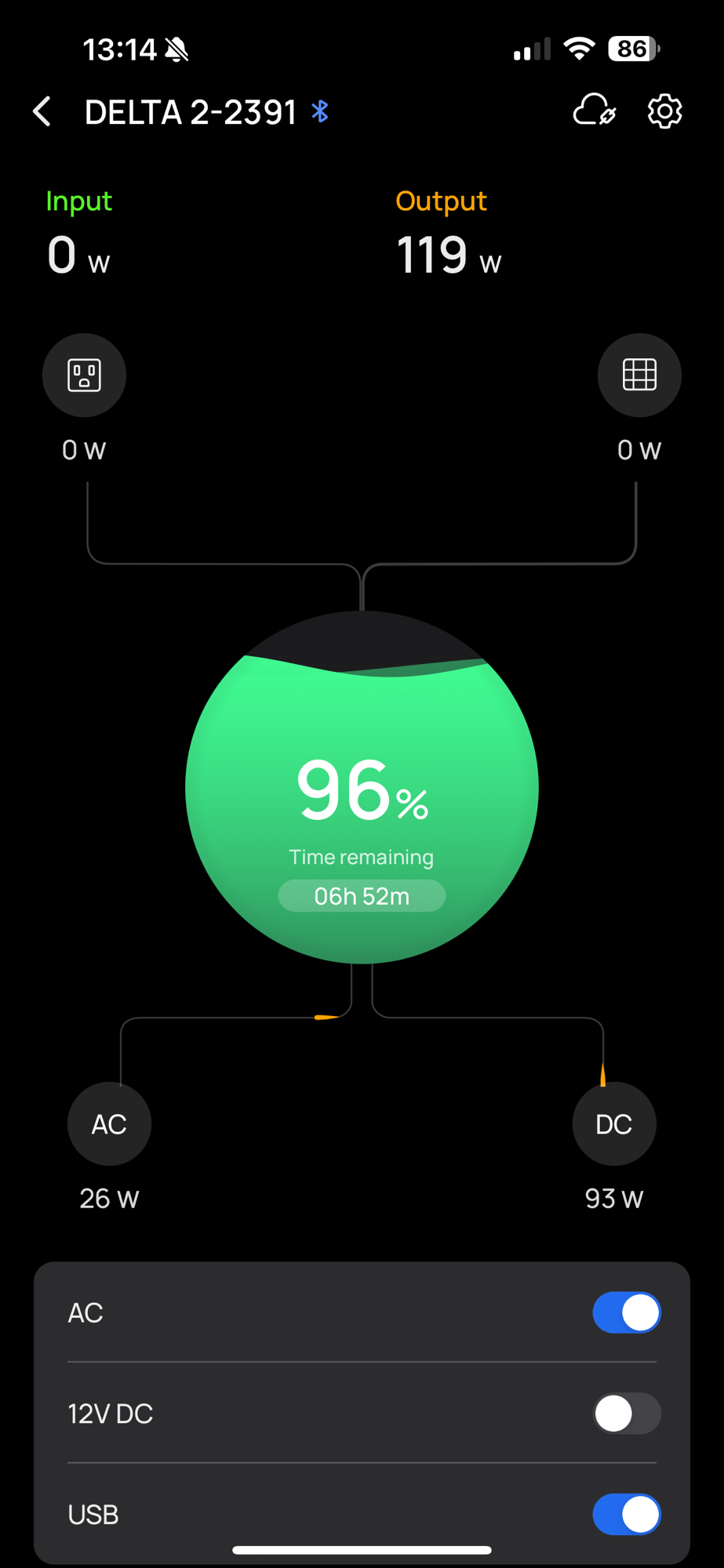
I use an iPhone app to monitor input and output in real time. This is great when you use your device (laptop, phone, tablet) in the living room, and the ECOFLOW powers your internet router in the office.
You can see how much power you’re drawing from the AC wall plug and the power supplied to your DC input port (solar or car alternator). At the same time, you can see the power you’re supplying to AC devices (through the inverter) and DC devices, either 12V DC or USB power ports.
Of course, as soon as the power outage ends, I make sure that the ECOFLOW is plugged in. You never know if the power will go out again. It’s good to have you’re battery charged, just in case.
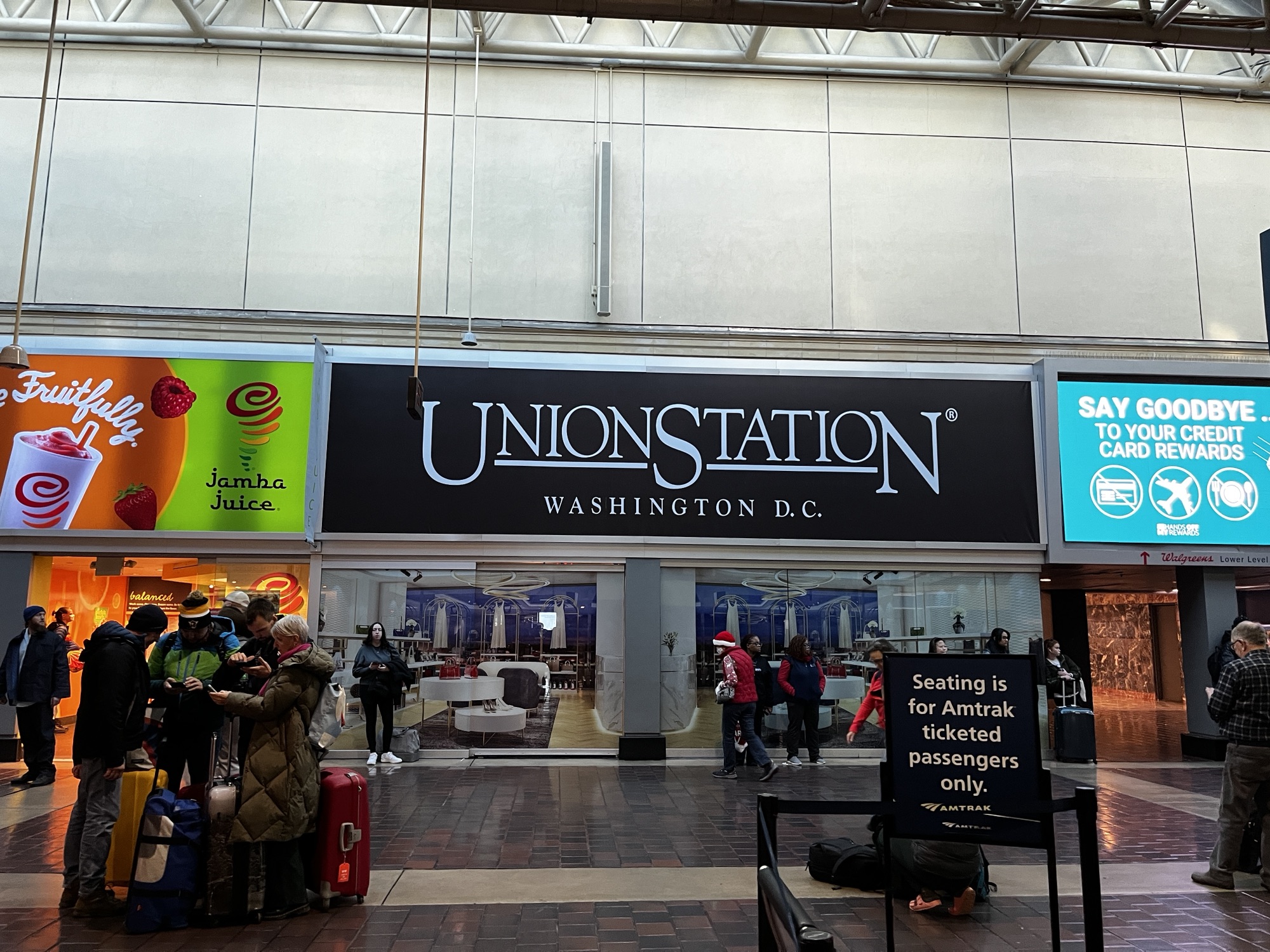
I arrived at DC Union Station at 12:40 on Friday. If I had to bet which station would be larger, I would have bet on Chicago. But Washington, DC was much bigger. There were lots of tracks, but the inside of the station screamed spaciousness. The tree was pretty tall but didn’t come close to the ceiling.
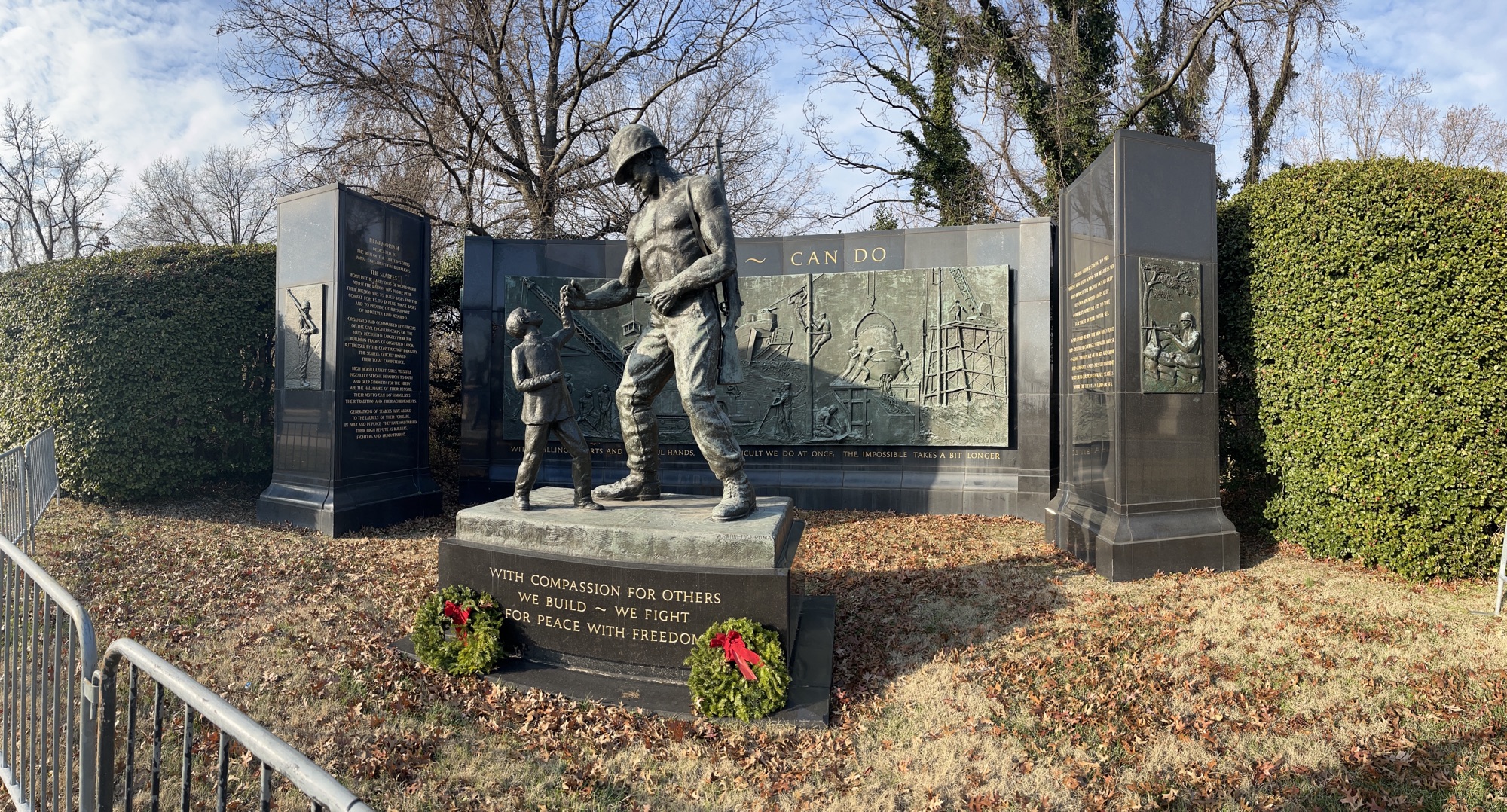
I walked out of the station since all I had was a backpack and no checked bags. I took a cab straight to my hotel and realized that I still had a lot of time before Arlington National Cemetary closed. So, I put on my heavy jacket (which it turned out that I didn’t need) and started walking toward the Whitehouse, I planned to go around to the World War II Memorial, then hang a left down the Mall to the Lincoln Memorial and across the Arlington Memorial Bridge and into the cemetery.
When I got to Lafayette Square, I realized why Google Maps didn’t take me that way. There was some sort of demonstration happening at the same time some dignitary was leaving the Whitehouse grounds. I had to hang a left and came out on 15th St NW right between the National Museum of African American History and Culture (which I’d see later) and the Washington Monument. From there, I walked down Constitution Ave NW and picked up my intended route.
A couple miles later, I found that there was a rail station at ANC on the blue line which comes out right by my hotel. I went through security, got my bearings and walked out to my dad’s spot. After spending a little time there, I took the subway back to my hotel and got some dinner.
The next morning, I had planned to go to the National Museum of African American History and Culture but learned that, due to its popularity, visitors need tickets to get in. The museum is still free like the other Smithsonian Museums, but the tickets create reservations at different times of the day to keep the museum from getting too crowded. There were no tickets available for Saturday. So, I booked 11:30 on Sunday.
This gave me some free time on Saturday. When I planned this trip, I was concerned about having too big of a carry-on bag for the flight home. Kelley suggested that I mail my laundry back to the house so that I don’t have to carry it on the plane. This break on Saturday gave me enough time to get it done since the FedEx Office store was closed on Christmas Eve. I took a box that the bell desk had that seemed way too big and filled it with all of my laundry. I mailed it home at the slowest speed possible, to keep from getting gouged with Christmas shipping prices.
I had made plans for Saturday afternoon to go watch the Liverpool – Arsenal game at a local Liverpool supporter bar called The Queen Vic. I decided to walk there, which was a mistake because I arrived 4 minutes before game time after a 2.5-mile walk. There was no place to sit and barely any place to stand, which made it great. There were two bars and a back room all of them had the game on the TVs. Everyone had one thing in common, they were cheering for the same team.
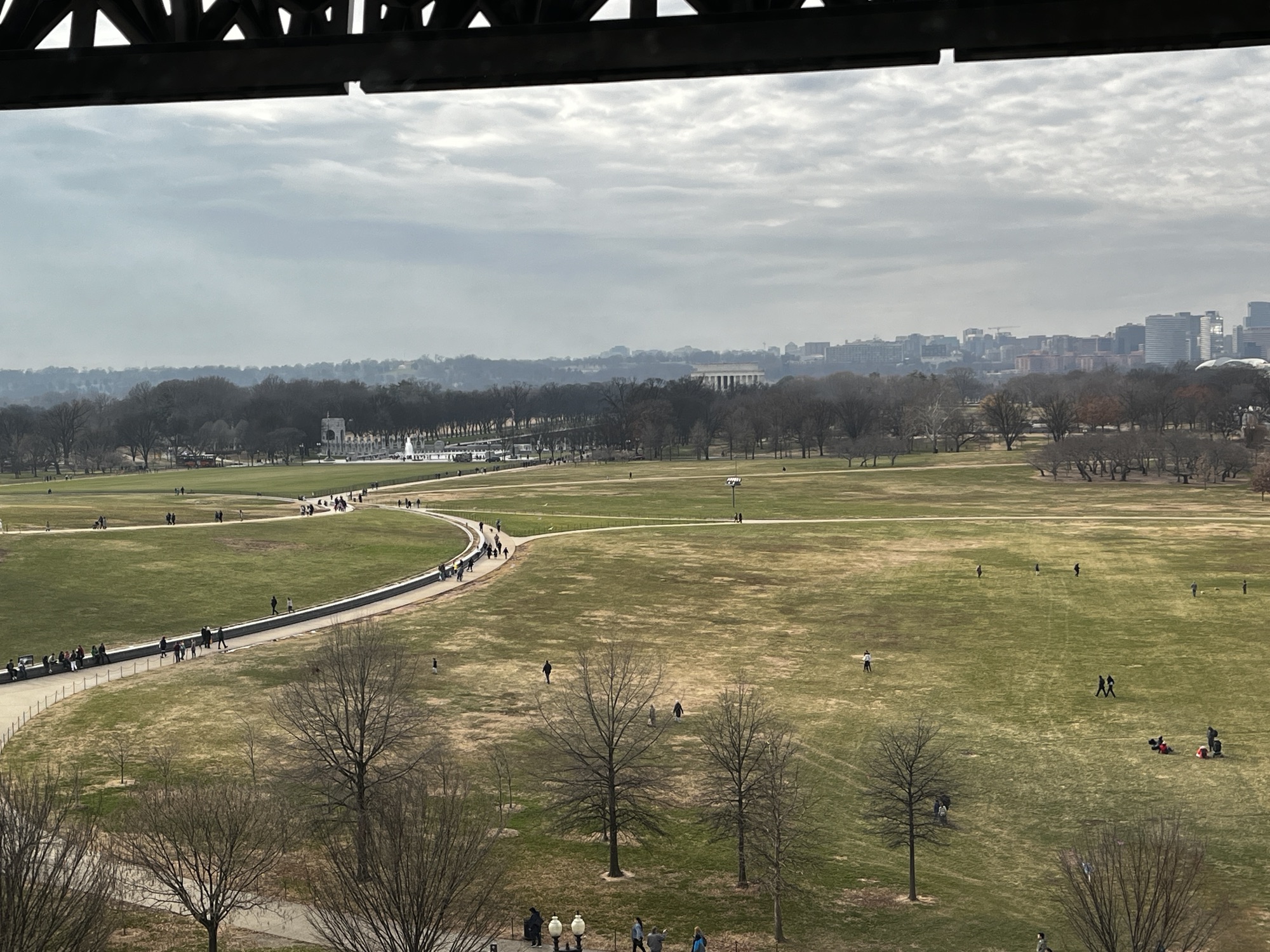
Sunday Morning, I went to the National Museum of African American History and Culture. It was really good. I took a lot of pictures, mostly of things that I wanted to learn more about. But this one picture that I really loved was the view of the Lincoln Monument from the top floor of the museum.
I went to lunch at P.J. Clarkes and had a nice lobster roll, then went to the airport.
Flying on Christmas Eve was a lot easier than I thought it would be. I was the only person in line for airport security. The gate wasn’t crowded, with lots of empty seats to use. The only hiccup was that the plane was late coming in which delayed our takeoff for a couple of hours, but I was notified via text about that 7 hours before it happened. I landed in Seattle a few minutes after 11 pm, where my daughter picked me up and drove me home.



 Daniel Gregson
You must be logged in to post a comment.