I recently bought an ECOFLOW Delta 2. I usually prefer to build my own battery pack, but this one was on sale on Amazon, and I was curious about how it would perform for some high-wattage AC applications.
The device is pretty easy to set up. You take it out of the box and plug it into an AC socket to charge. I had a dedicated circuit for my old refrigerator that wasn’t in use anymore. I figured this would allow it to draw a lot of power without tripping a circuit breaker.
It’s pretty light. I can carry it around in one hand while opening doors with the other. This may not be the case for everyone, but I don’t regard myself as having a lot of upper body strength.
The ECOFLOW Delta 2 feature set meets my needs. With an 1800-watt inverter inside, I can plug in a water kettle, a coffee maker, a microwave, or an induction plate. Granted, I can’t plug in more than one of these at a time. I really don’t need to, though. To boil water in a Kettle takes about 5% of the battery life. Similarly, I can cook eggs on the 600 W setting in short order with my induction plate. Since the battery life is measured in Watts-hours, using a lot of watts for a short time leaves power in reserve for other applications.
I also have a K-cup coffee maker that uses 860 watts. The 5% of battery life is a good trade-off when the power is out.
Most of these experiments were done on the bus. I went to a tournament and made coffee in the parking lot, or I was in a park and made a Mountain House meal that required 10 oz of boiling water. Being able to do these things in places without electricity hookups is excellent.
The batteries can be charged via an electrical cord plugged into an AC or a DC line that runs from solar panels or a car cigarette lighter plug. In the recent power outage on the island, my wife drove around with the ECOFLOW in her car and restored 15% of the power to the battery. In a long-lasting power outage, this would
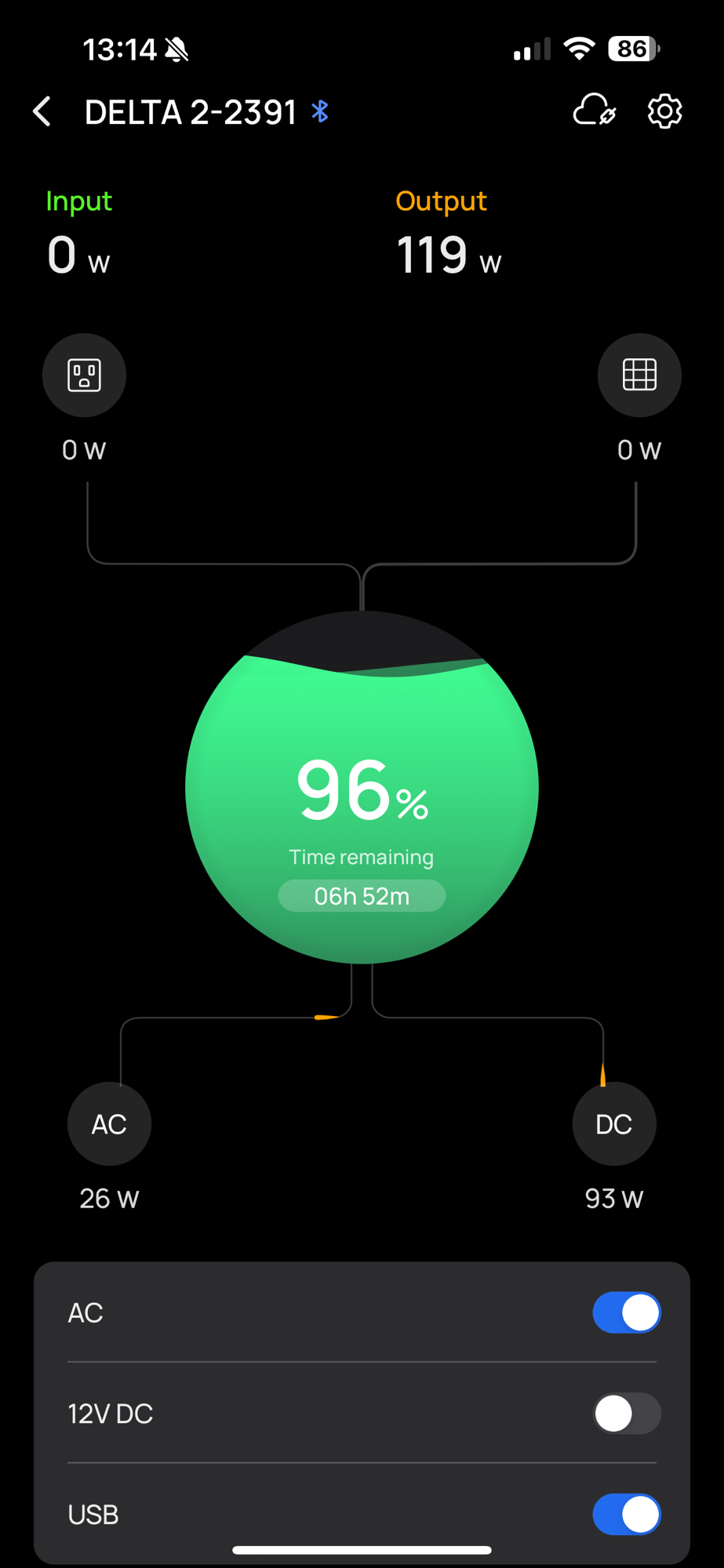
I use an iPhone app to monitor input and output in real time. This is great when you use your device (laptop, phone, tablet) in the living room, and the ECOFLOW powers your internet router in the office.
You can see how much power you’re drawing from the AC wall plug and the power supplied to your DC input port (solar or car alternator). At the same time, you can see the power you’re supplying to AC devices (through the inverter) and DC devices, either 12V DC or USB power ports.
Of course, as soon as the power outage ends, I make sure that the ECOFLOW is plugged in. You never know if the power will go out again. It’s good to have you’re battery charged, just in case.


 Daniel Gregson
You must be logged in to post a comment.